Utility Helpers
lib/utils.js is the shared utility module behind request parsing, response metadata, content handling, proxy handling, and query-string processing. Its dependencies include content-type, etag, mime-types, proxy-addr, qs, and node:querystring.
The module exists to keep cross-cutting transformations outside the request and response objects themselves. The application turns settings into callable functions, the request object invokes the configured query parser, and the response object invokes the configured ETag generator.
Sources: lib/utils.js:16, lib/utils.js:17, lib/utils.js:18, lib/utils.js:19, lib/utils.js:21, lib/application.js:351-380, lib/request.js:230-240, lib/response.js:162-165
Core concepts
Shared dependencies
A shared dependency is an external module loaded by lib/utils.js for use by its helpers.
| Utility dependency | Plain-language role |
|---|---|
contentType | Imported from the content-type package. |
etag | Called to calculate an ETag from a buffer. |
mime | Imported from the mime-types package. |
proxyaddr | Imported from the proxy-addr package. |
qs | Used to parse an extended query string. |
querystring | Imported from node:querystring. |
The imports establish these module variables, while the shown helper bodies demonstrate the etag and qs call sites.
Sources: lib/utils.js:16, lib/utils.js:17, lib/utils.js:18, lib/utils.js:19, lib/utils.js:21, lib/utils.js:249-257, lib/utils.js:267-271
Parsed request metadata
Parsed request metadata is the structured result returned by acceptParams from a semicolon-delimited string.
The result contains a value, a numeric quality, and a params object; a q key updates quality, while other keys are stored in params.
Sources: lib/utils.js:89-120
ETag generator
An ETag generator is a function that converts a response body into a buffer when necessary and passes that buffer to etag.
The helper returned by createETagGenerator accepts both a body and an encoding, preserving an existing buffer and using Buffer.from for other bodies.
Sources: lib/utils.js:249-257
Extended query parser
An extended query parser is a function that delegates parsing to qs.parse with prototype properties explicitly allowed.
The shown helper therefore centralizes one particular query-string parsing operation; the supplied excerpts do not show how it is registered in application settings.
Sources: lib/utils.js:267-271
How shared helpers serve requests and responses
The request and response modules consume different configured helpers. A request reads query parser fn; if no parser is configured, it returns an object created without a prototype, otherwise it parses the URL query and passes the result to that function.
A response reads etag fn before sending data. ETag generation is eligible only when the response does not already have an ETag header and the configured value is a function.
This division keeps the request and response objects focused on HTTP behavior while lib/utils.js owns reusable conversion and parsing logic. The application connects settings to those helpers when app.set receives etag, query parser, or trust proxy.
Sources: lib/request.js:230-240, lib/response.js:162-165, lib/application.js:351-380
How a response body becomes an ETag
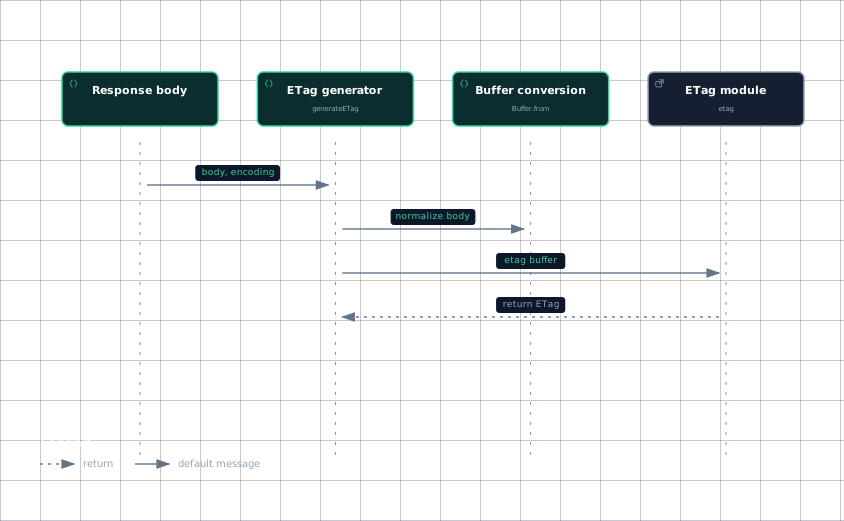
The ETag path begins with the response’s configured function. When the response has a body length and ETag generation is enabled, the response calls the configured function with the body and encoding, then sets the resulting value as ETag when one is returned.
The utility generator normalizes the body first. Existing buffers pass through unchanged; other bodies are converted with Buffer.from(body, encoding). The resulting buffer is then passed to etag(buf, options).
Evidence
- bodylib/response.js:189
- generatorlib/utils.js:249
- bufferlib/utils.js:249
- etag-modulelib/utils.js:17
- etag-modulelib/utils.js:249
The important distinction supported by the excerpts is that etag is the imported dependency and callable used to calculate the tag, while createETagGenerator is the adapter that normalizes the body and supplies options. The supplied code does not show a wetag symbol, setting, or implementation, so no additional code-backed difference between etag and wetag can be stated.
A manually supplied ETag is preserved because generation requires that the response not already have an ETag header. A response with no body does not receive an ETag in the shown tests.
Sources: lib/response.js:189-193, lib/utils.js:249-257, lib/utils.js:17, lib/response.js:162-165, test/res.send.js:455-483
How settings become callable functions
The application’s settings layer performs the conversion. Setting etag stores the value and also assigns compileETag(val) to etag fn; setting query parser assigns compileQueryParser(val) to query parser fn; setting trust proxy assigns compileTrust(val) to trust proxy fn.
| Setting | Compiler | Stored callable setting |
|---|---|---|
etag | compileETag | etag fn |
query parser | compileQueryParser | query parser fn |
trust proxy | compileTrust | trust proxy fn |
The table reflects the setting-to-function assignments shown in app.set; the excerpts do not show the later consumer for trust proxy fn.
The excerpts show that compileTrust and compileQueryParser are imported from ./utils and invoked when settings change, but they do not include the compiler bodies or enumerate the accepted setting-value forms. Consequently, the grounded explanation is that each compiler turns the setting value into the corresponding callable configuration; the exact conversion rules are outside the supplied excerpts.
Sources: lib/application.js:351-380, lib/application.js:16-25, lib/application.js:363-372
How it connects
lib/application.js is the configuration boundary: it imports compileETag, compileQueryParser, and compileTrust, then refreshes derived function settings through app.set. For the surrounding application lifecycle, see App Configuration & Settings.
lib/request.js consumes query parser fn when exposing req.query, while lib/response.js consumes etag fn while sending a body. Read The Request Object and Response: Sending Data for those public surfaces.
The application itself is created with request and response prototypes that are exposed through app.request and app.response; those prototypes are where utility-backed behavior becomes part of Express’s HTTP API. See Express Overview for the package entry point.
Sources: lib/application.js:16-25, lib/application.js:351-380, lib/request.js:230-240, lib/response.js:162-165, lib/response.js:189-193, lib/express.js:36-65
Key takeaways
- lib/utils.js centralizes reusable parsing, conversion, and dependency-backed helpers.
createETagGeneratornormalizes a body to a buffer and delegates tag generation toetag.- Responses use
etag fn; requests usequery parser fn. - app.set derives callable settings through
compileETag,compileQueryParser, andcompileTrust. - The supplied excerpts do not define
wetagor the detailed accepted values for the compiler helpers.
Sources: lib/utils.js:16, lib/utils.js:17, lib/utils.js:89-120, lib/utils.js:249-257, lib/utils.js:267-271, lib/request.js:230-240, lib/response.js:162-165, lib/application.js:351-380, lib/application.js:16-25