Test Suite Organization and Patterns
Click’s tests are organized by the behavior they protect: commands, arguments, options, contexts, parsing, completion, utilities, exceptions, and typing examples.
The suite exists to exercise Click through realistic command definitions and invocations, then inspect output, return values, exceptions, or help text.
Sources: tests/test_basic.py:12-28, tests/test_commands.py:8-21, tests/test_options.py:23-36, tests/test_context.py:17-36, tests/test_parser.py:18-19, tests/test_utils/test_echo.py:12-33, tests/test_exceptions/test_FileError.py:4-6, tests/typing/typing_simple_example.py:11-14, tests/test_arguments.py:14-24, tests/test_basic.py:131-138
Core concepts
Core behavior tests
Core behavior tests check ordinary command construction, groups, options, help, return values, and common parameter types. tests/test_basic.py contains these broad scenarios.
Sources: tests/test_basic.py:12-28, tests/test_basic.py:131-138, tests/test_basic.py:141-164, tests/test_basic.py:479-520
Argument tests
Argument tests cover positional declarations, arity, names, environment variables, files, defaults, help, deprecation, and custom argument classes. tests/test_arguments.py contains both invocation-based tests and direct checks of click.Argument.
Sources: tests/test_arguments.py:14-24, tests/test_arguments.py:111-116, tests/test_arguments.py:471-490, tests/test_arguments.py:547-564, tests/test_arguments.py:661-677, tests/test_arguments.py:1178-1199
Option tests
Option tests cover option prefixes, invalid arity, environment variables, required values, custom validation, deprecation, and custom option classes. tests/test_options.py concentrates behavior that is specific to options.
Sources: tests/test_options.py:23-36, tests/test_options.py:133-139, tests/test_options.py:447-457, tests/test_options.py:1006-1021, tests/test_options.py:1088-1099, tests/test_options.py:1236-1249
Command-dispatch tests
Command-dispatch tests focus on invoking other commands, forwarding parameters, custom parsers, object propagation, aliases, and option-processing order. tests/test_commands.py isolates composition and dispatch behavior.
Sources: tests/test_commands.py:8-21, tests/test_commands.py:24-41, tests/test_commands.py:144-207, tests/test_commands.py:210-228, tests/test_commands.py:329-346, tests/test_commands.py:401-419
Context tests
Context tests check context objects, current-context lookup, metadata, close callbacks, exit behavior, resources, and parameter sources. tests/test_context.py is the focused module for this stateful behavior.
Sources: tests/test_context.py:17-36, tests/test_context.py:133-136, tests/test_context.py:143-159, tests/test_context.py:336-354, tests/test_context.py:522-535, tests/test_context.py:766-774
Focused subsystem tests
Focused directories isolate narrower areas: tests/test_types/ contains a Choice test, tests/test_utils/ contains echo tests, and tests/test_exceptions/ contains a FileError test.
Sources: tests/test_types/test_Choice.py:4-7, tests/test_utils/test_echo.py:12-33, tests/test_exceptions/test_FileError.py:4-6
Typing examples
Typing files provide typing-oriented examples rather than the shown runtime invocation pattern. The supplied catalog identifies hello in tests/typing/typing_simple_example.py; it does not show a runner.invoke call or runtime output assertion for that file.
Sources: tests/typing/typing_simple_example.py:11-14, tests/test_arguments.py:14-24
How the tests are split by subsystem
The main test modules keep related behavior together, while focused directories cover narrower contracts. The following map summarizes the visible split.
| Area | Main concern | Representative tests |
|---|---|---|
| Core behavior | Commands, groups, help, options, flags, paths, choices, and dates | test_basic_functionality, test_basic_group, test_boolean_flag, test_path_option, test_choice_option |
| Arguments | Positional values, arity, names, files, defaults, and help | test_nargs_star, test_argument_names, test_file_args, test_argument_help |
| Options | Prefixes, arity, environment variables, validation, and required values | test_prefixes, test_invalid_nargs, test_multiple_envvar, test_custom_validation, test_required_option |
| Commands | Invocation, forwarding, custom parsers, aliases, and processing order | test_other_command_invoke, test_other_command_forward, test_custom_parser, test_aliased_command_canonical_name |
| Context | Objects, metadata, cleanup, exits, and parameter sources | test_ensure_context_objects, test_context_meta, test_close_before_pop, test_parameter_source |
| Parser and completion | Argument splitting, prefixes, commands, options, paths, and choices | test_split_arg_string, test_parser_collects_prefixes, test_command, test_path_types |
test_types/ | Focused parameter-type behavior | test_choice_get_invalid_choice_message |
test_utils/ | Echo, streams, colors, and input setup | test_echo, test_echo_custom_file, test_echo_color_flag, emulate_input |
test_exceptions/ | Exception-specific behavior | test_file_error_surrogates |
typing/ | Typing examples | hello |
These groups are complementary: the main modules exercise end-to-end command behavior, while the subdirectories narrow attention to types, utilities, exceptions, and typing.
A normal runtime test moves from a test function to a decorated command, then through runner.invoke, and finally to assertions over the returned result.
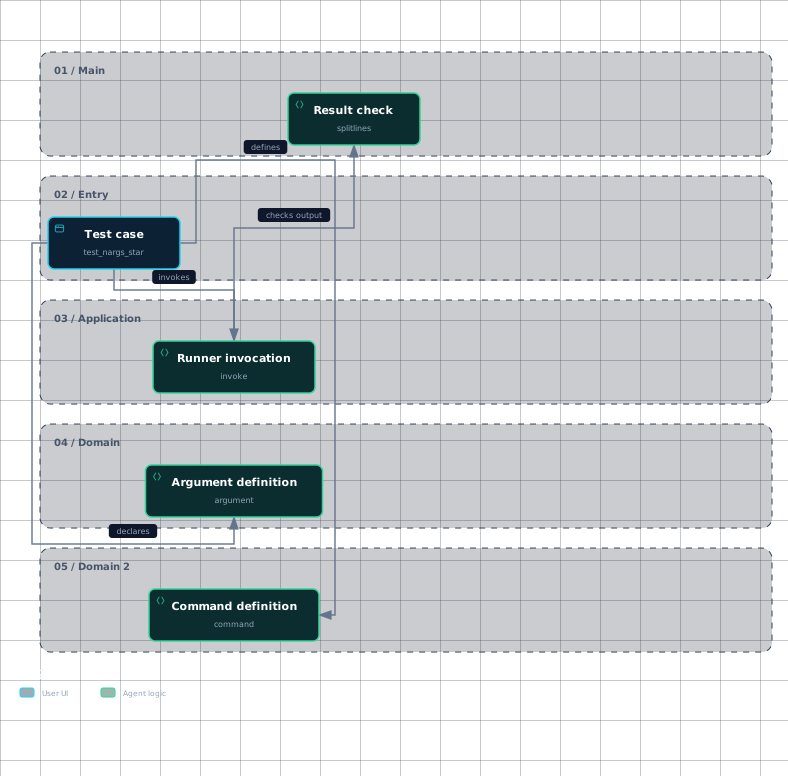
Evidence
- test-casetests/test_arguments.py:14
- command-definitiontests/test_arguments.py:14
- argument-definitiontests/test_arguments.py:14
- runner-invocationtests/test_arguments.py:14
- result-checktests/test_arguments.py:14
The shared runner fixture returns a CliRunner, so tests can reuse the same invocation boundary without constructing it in every test.
Sources: tests/test_basic.py:12-28, tests/test_arguments.py:14-24, tests/test_options.py:23-36, tests/test_parser.py:18-19, tests/test_types/test_Choice.py:4-7, tests/test_utils/test_echo.py:12-33, tests/test_exceptions/test_FileError.py:4-6, tests/typing/typing_simple_example.py:11-14, tests/conftest.py:7-8
How shared fixtures and parametrization work
tests/conftest.py provides runner; visible users include argument tests, basic behavior tests, command-dispatch tests, context tests, option tests, shell-completion tests, and utility tests.
The fixture-centered pattern is explicit in test_nargs_star: the test receives runner, defines a command and argument, invokes the command, then checks the result.
def test_nargs_star(runner):
    @click.command()
    @click.argument("src", nargs=-1)
    @click.argument("dst")
    def copy(src, dst):
        click.echo(f"src={'|'.join(src)}")
        click.echo(f"dst={dst}")

    result = runner.invoke(copy, ["foo.txt", "bar.txt", "dir"])
    assert not result.exception
    assert result.output.splitlines() == ["src=foo.txt|bar.txt", "dst=dir"]
The important separation is that the fixture supplies the runner, while the test owns the command definition and the expected observable behavior.
Parametrization lets one test body cover families of declarations and values: argument names vary across declarations, nargs tests vary input shapes, defaults and environment-variable tests vary values, and command-processing tests vary ordering.
Some tests deliberately expand combinations instead of using one example. test_parameter_name_is_an_identifier_or_deprecated forms products of declaration variants and checks both click.Option and click.Argument, which makes the naming rule cover many spellings and exposure modes.
The representative call order is shown below.
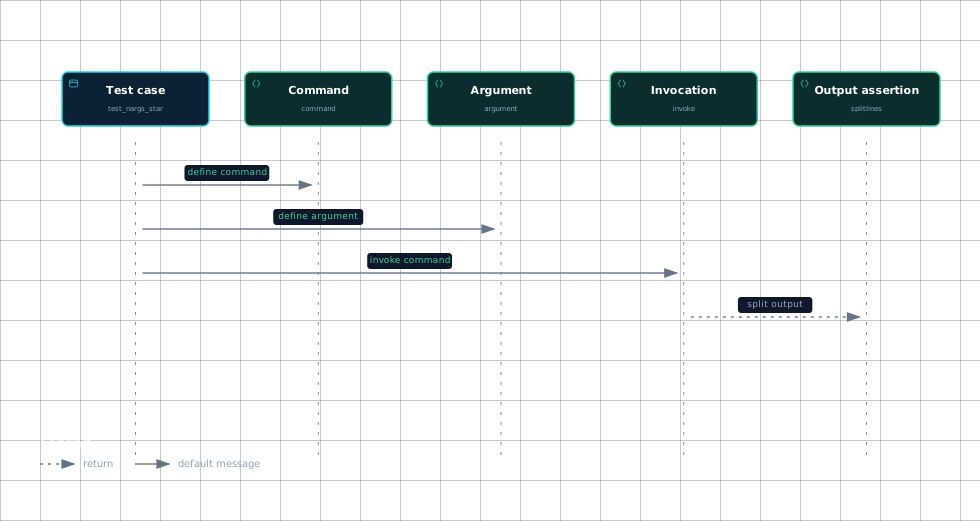
Evidence
- test-casetests/test_arguments.py:14
- commandtests/test_arguments.py:14
- argumenttests/test_arguments.py:14
- invocationtests/test_arguments.py:14
- assertiontests/test_arguments.py:14
Sources: tests/conftest.py:7-8, tests/test_arguments.py:14-24, tests/test_basic.py:12-28, tests/test_commands.py:8-21, tests/test_context.py:17-36, tests/test_options.py:23-36, tests/test_utils/test_echo.py:12-33, tests/test_arguments.py:98-108, tests/test_arguments.py:547-564, tests/test_arguments.py:971-989, tests/test_commands.py:401-419, tests/test_arguments.py:166-189
How typing tests differ from runtime tests
Runtime tests execute commands and inspect behavior, such as output, exit status, exceptions, or return values.
The visible typing evidence is narrower: it identifies hello in tests/typing/typing_simple_example.py, but does not show a runner, invocation, or runtime assertion. The safe distinction is therefore that typing files demonstrate the typing surface, while ordinary runtime tests prove behavior by execution.
Sources: tests/test_arguments.py:14-24, tests/test_basic.py:12-28, tests/test_basic.py:131-138, tests/typing/typing_simple_example.py:11-14
How it connects
Use Testing with CliRunner for the runner and CliRunner invocation boundary.
Use The Parameter Model when following how argument and option declarations become parameters under test.
Use Commands and Groups when tracing dispatch, forwarding, aliases, and subcommands.
Use Context and Execution when a test depends on ctx.obj, current-context lookup, cleanup, or parameter sources.
Use Repository Layout and Dev Setup for the broader repository placement of tests/ and its focused subdirectories.
Sources: tests/conftest.py:7-8, tests/test_arguments.py:14-24, tests/test_arguments.py:111-116, tests/test_options.py:23-36, tests/test_commands.py:8-21, tests/test_commands.py:24-41, tests/test_commands.py:329-346, tests/test_context.py:133-136, tests/test_context.py:336-354, tests/test_context.py:766-774, tests/test_types/test_Choice.py:4-7, tests/test_utils/test_echo.py:12-33, tests/test_exceptions/test_FileError.py:4-6
Key takeaways
- The suite separates broad command behavior from focused type, utility, exception, and typing tests.
- tests/conftest.py provides
runner, which returnsCliRunner. - Runtime tests commonly define a command, invoke it, and assert output, status, exceptions, or return values.
- Parametrization expands one test body across declarations, values, defaults, and processing orders.
- Typing files are represented by examples such as
hello, not by the shown runtime invocation pattern.